
Falling Snow
Notes on the Exquisite Nature of Snowflakes

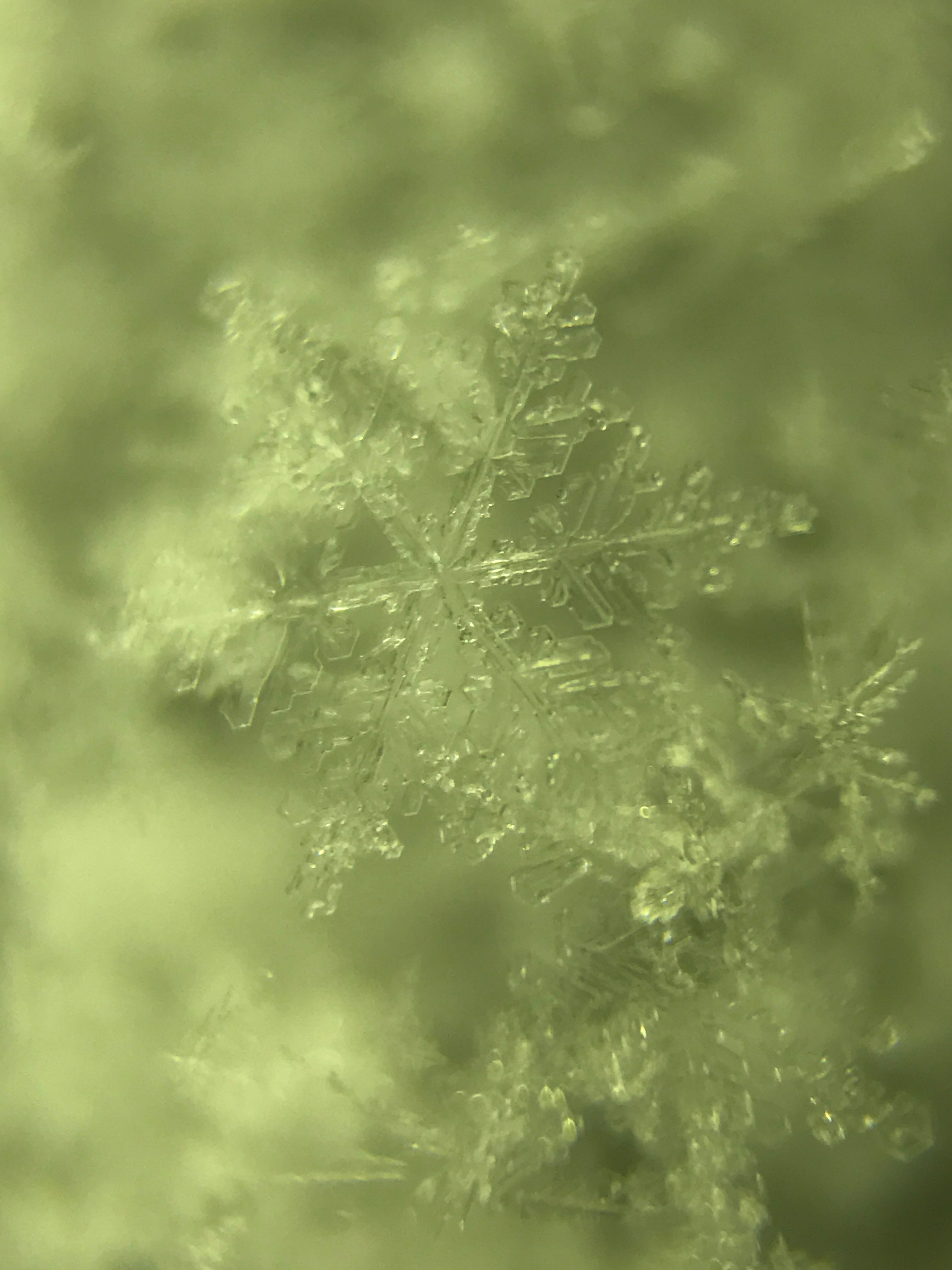
Under the microscope, I found that snowflakes were miracles of beauty; and it seemed a shame that this beauty should not be seen and appreciated by others. Every crystal was a masterpiece of design and no one design was ever repeated. When a snowflake melted, that design was forever lost. Just that much beauty was gone, without leaving any record behind.
-Wilson “Snowflake” Bentley, 1925
Many years ago, when living in a little townhouse in the middle of Pittsburgh, I discovered for myself that it’s possible to see the fractaled beauty of an individual snowflake. It was late one night and the glass door in the kitchen that led out to our tiny yard gave me a vantage point of the snow that was falling. I noticed a brilliant sparkling on the stoop. Not thinking much of it, I continued washing dishes. Again, the same sparkle caught my eye. Opening the door and bending down, my breath was caught as I realized that the sparkle was from a single snowflake positioned just so to catch the indoor lights. Dropping down to lying on the floor, I counted the 6 sides and marveled that never once in my life before then had I realized one could see with the naked eye the shape of snowflakes. I was astonished. That moment many years ago was a doorway to a land I didn’t know existed.
Wondering about this phenomenon of being able to see snowflakes with my own unaided eyes, I learned of a man named Wilson “Snowflake” Bentley who lived in Vermont in the 19th century. In January 1885, he became the first person to capture a snowflake with photography. Over a lifetime, he gathered a volume of work with thousands of snowflake crystals, no two alike.
Thought to be somewhat nutty by neighbors and his own father, I prefer to think Wilson Bentley was someone who had learned a different way of seeing the world. Where many view snow as a nuisance and something to be endured, his longing for and excitement over the snowfall contributed greatly to our human understanding of snow through his passionate pursuit of capturing the momentary beauty of snow crystals.
Longfellow said that genius is infinite painstaking. John Ruskin declared that genius is only a superior power of seeing. Wilson Bentley was a living example of this type of genius. He saw something in the snowflakes which other men failed to see, not because they could not see, but because they had not the patience and the understanding to look.
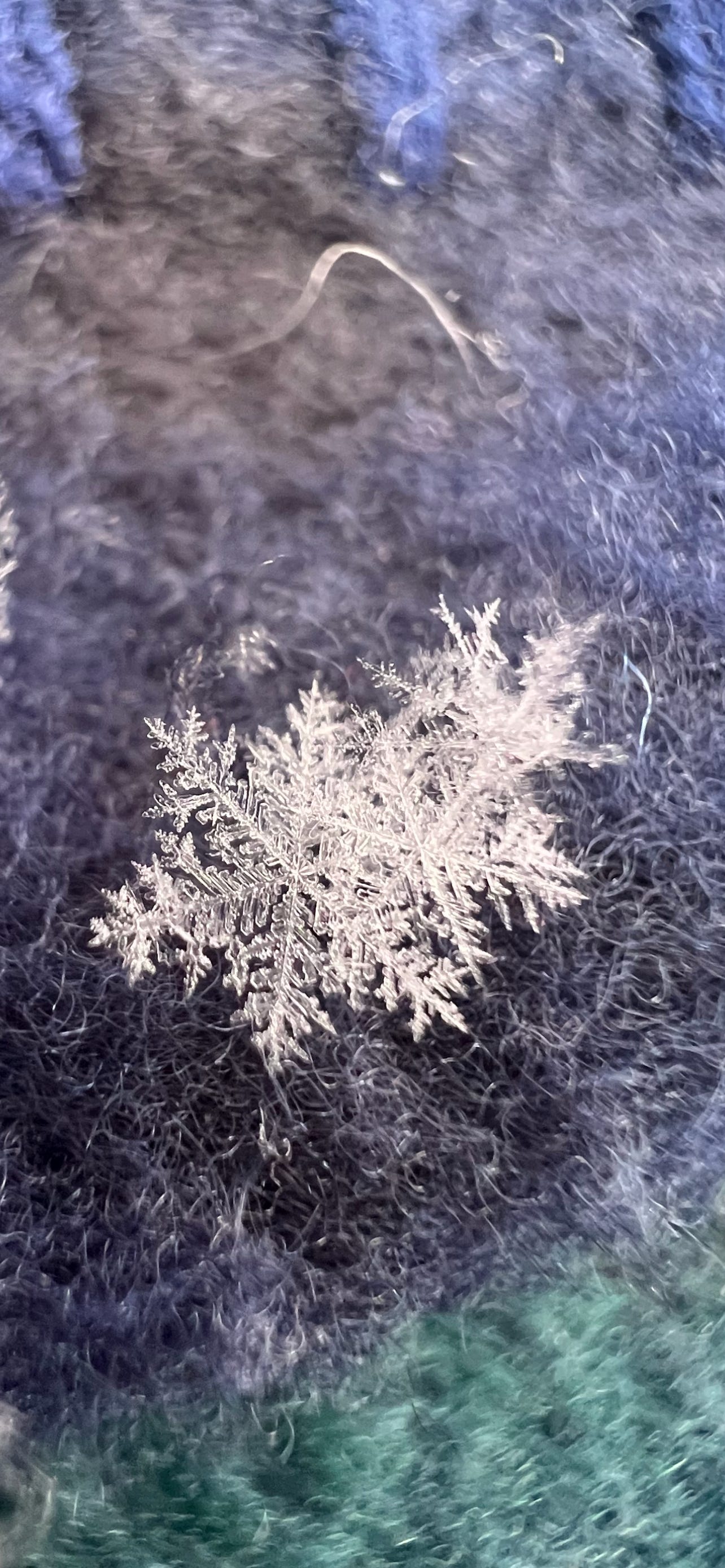
The years since that moment with the sparkling snowflake on the stoop have found me, like Snowflake Bentley, frozen fingered outside in all snowy conditions trying to capture snowflakes, holding my breath to avoid melting my subject. I’ve tried the fancy camera, screw on phone microscopes, magnifying glasses, and more, but usually it’s just my phone that I use. I throw down a wool scarf or hat for contrast and wait for the flakes to land. Often, they’re clumped or too far melted to show their uniqueness. For every decent shot, there are dozens of blurry photos.
There is a certain something about capturing something so temporary and momentary, yet entirely unique. Something that would blend into a blanket of white except for a brief moment in time if an onlooker happened to notice it.
The snow crystals . . . come to us not only to reveal the wondrous beauty of the minute in Nature, but to teach us that all earthly beauty is transient and must soon fade way. But though the beauty of the snow is evanescent, like the beauties of the autumn, as of the evening sky, it fades but to come again.
-Wilson A. Bentley
While I can honestly say the natural world holds the most wondrous curiosities to me, snowflakes are perhaps the thing in nature I love the most.
Snowflakes show how a single drop of water attached to a speck of dust can take nearly infinitesimal shapes before melting back into a perfect water drop orb, reflecting the observer in the water tension before finding a river to make their way back to or a cloud to evaporate into. The stories a single snowflake could tell, of all the places its water droplet have been throughout time, are vast. Perhaps, if we could listen beyond our own language, we’d see they are telling their stories through their forms.
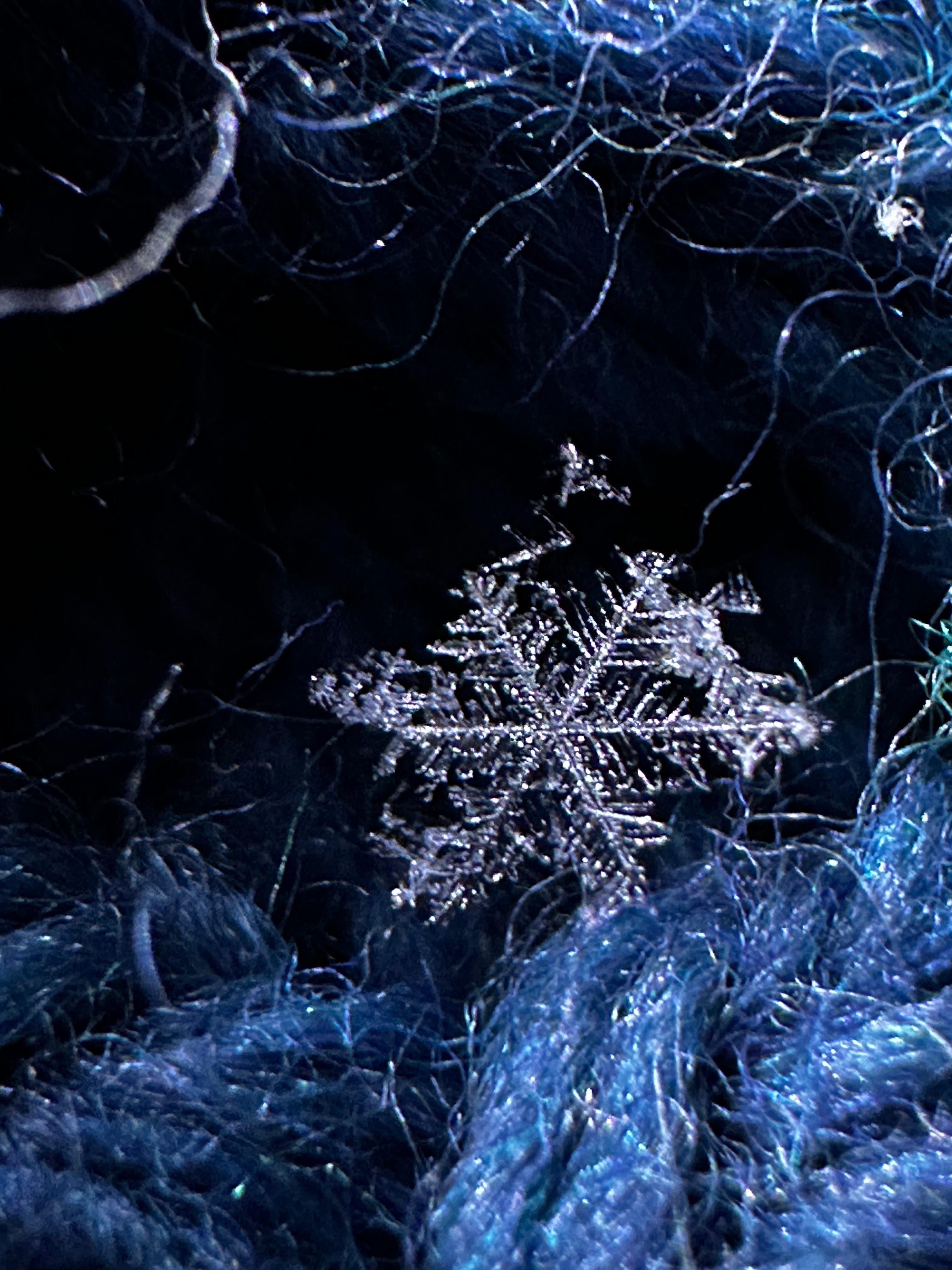
Was ever life history written in more dainty hieroglyphics!
Wilson Bentley, 'A Study of Snow Crystals' in Popular Science Monthly May 1898
I’m back in East Tennessee, where I grew up never seeing very much snow and certainly never realizing one could count the 6 sides of snowflakes. Conditions do matter and not all snow that falls is formed in the right conditions for those brilliant shapes to form, but just the other day some snow was swirling around and holding my breath I tried to capture the flakes before they melted almost as quickly as they were falling. There’s something a little aching about the imperfection of a snowflake that manages to land when the temperature isn’t quite freezing. When I lived further north, I’d go out often, but not always, to see what snow crystals were waiting for the moment to be seen, but here the snow is much more rare and it’s a priority for me to find myself outside trying to say hello to as many as I can before they melt into the ground.
It’s incredible to me to think an entire landscape can become completely blanketed in deep piles of tiny snowflakes. Those inches that pile up are made of individual snow crystals. Flake by flake, snow can blanket an entire landscape, filling in the nooks and crannies such that the whole world seems as if it were draped in a blanket of white.
Suppose we did our work
like the snow, quietly, quietly.
leaving nothing out.
Wendell Berry from his collection Leavings, (Counterpoint, 2009)
Some of my favorite times have been when I’ve been out late at night, with a fresh blanket of snow and more falling, just sitting in the utter quiet. Have you ever noticed how quiet is is when it snows?
The reason snow is able to absorb sound is because it is porous. Snowflakes are six-sided crystals, and they are filled with open spaces, according to the Michigan State University Extension. Those spaces absorb sound waves, creating a quieting effect over a blanket of snow.
Of course, some of my fondest memories are of my children playing in the snow, making snow forts and snow angels, pounding each other with snow balls, or skiing faster than I ever could down slopes. Many snow days have been spent passing mugs of hot cocoa out to them. Like me, they never seem to tire of being in the snow and are never more playful than when snowflakes are whirling through the air. There is a whimsy to snow that seems to bring out wonder in us.
I counted till they danced so
Their slippers leaped the town –
And then I took a pencil
To note the rebels down –
And then they grew so jolly
I did resign the prig –
And ten of my once stately toes
Are marshalled for a jig!
Snowflakes. (45) by Emily Dickinson
It’s no surprise to me that many of my favorite authors and poets, Mary Oliver, Wendell Berry, Emily Dickinson, and others, were or are enthralled by snow. In her piece First Snow, Mary Oliver says what I wish I could so beautifully articulate.
The snow
began here
this morning and all day
continued, its white
rhetoric everywhere
calling us back to why, how,
whence such beauty and what
the meaning; such
an oracular fever! flowing
past windows, an energy it seemed
would never ebb, never settle
less than lovely! and only now,
deep into night,
it has finally ended.
The silence
is immense,
and the heavens still hold
a million candles; nowhere
the familiar things:
stars, the moon,
the darkness we expect
and nightly turn from. Trees
glitter like castles
of ribbons, the broad fields
smolder with light, a passing
creekbed lies
heaped with shining hills;
and though the questions
that have assailed us all day
remain - not a single
answer has been found -
walking out now
into the silence and the light
under the trees,
and through the fields,
feels like one
“First Snow” by Mary Oliver
Have you had any particularly memorable experiences with snow? I’d love to hear.
I’m linking some resources below.
Thank you for reading! Please consider a free subscription to Whispers on the Wind.
Alexey Kljatov, gorgeous snowflake photography:
Snowflake Bentley Resources:
https://snowflakebentley.com/biography
https://snowflakebentley.com/snowflake-man-bio
Thank you for the reminder of the miraculous beauty of Nature. (How has it become necessary to be reminded?!) Clearly we live in a highly intelligent, complex and beautiful world. Wendell Berry, Mary Oliver, Emily Dickenson - yes, all would notice.
Lovely, thank you, Amanda.
This is lovely, Amanda!!!! I am a fellow snow lover toooooooo!!! Xo!! Thank you for sharing.